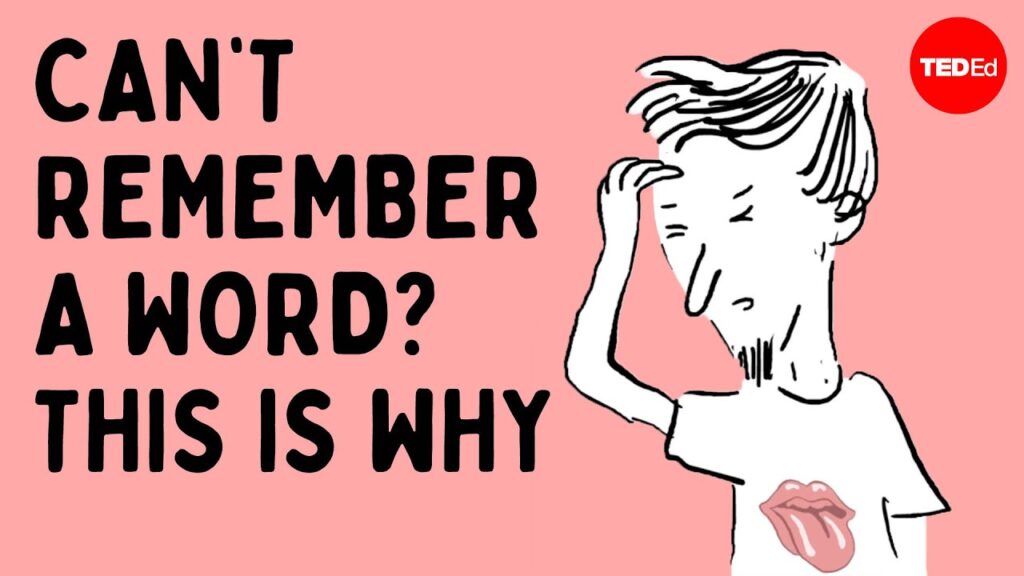
The tip-of-the-tongue (TOT) phenomenon occurs when you know a word but cannot recall it. The brain’s word retrieval process temporarily stalls, allowing meaning to surface but not the precise sound. It happens most with proper nouns, abstract words and low-frequency terms, influenced by multilingualism, age and stress. Cueing techniques using first letters or related clues can aid recall.
1. What is the Tip-of-the-Tongue Phenomenon?
The tip-of-the-tongue (TOT) phenomenon occurs when you are certain you know a word, yet you are frustratingly unable to recall it. The phrase “it’s on the tip of my tongue” perfectly captures this experience.
Cognitive psychology researchers explain that during these moments, the brain’s word retrieval process temporarily stalls. While we usually retrieve words quickly from extensive memory, in a TOT state the typical pathway breaks down: you may recall the word’s meaning and context, but not its precise sound (phonological information).
“TOT is not simple memory failure, but a temporary disconnection between semantic access and phonological access in the brain’s language network.”
2. What Happens in the Brain: Word Retrieval Mechanisms
Word recall involves cooperation between multiple brain regions:
- Wernicke’s area: Located in temporal lobe, handles word meaning
- Broca’s area: Located in frontal lobe, manages pronunciation and speech production
- Angular gyrus: In parietal lobe, converts visual/auditory information to language
- Frontal lobe: Manages working memory and word search strategies
During TOT, the semantic network activates but the connection to the phonological network weakens or blocks. For example, the concept “actress who played the lead in Wizard of Oz” surfaces, but the sound “Judy Garland” does not.
Maril et al.’s 2001 fMRI study showed strong activation in the dorsolateral prefrontal cortex (DLPFC) and anterior cingulate cortex (ACC) during TOT states, indicating intensive search effort. Meanwhile, temporal lobe activation was lower than normal, suggesting weakened semantic-phonological connection.
3. Which Words Are Most Vulnerable?
TOT does not affect all words equally. Certain types are far more susceptible:
3-1. Proper Nouns
Person names, place names and brand names are the most common TOT targets, as they have unique phonological forms with fewer associations to other words.
3-2. Low-Frequency Words
Words rarely used in daily life have weaker connections in the brain’s language network, making TOT more likely.
3-3. Abstract Words
Abstract concepts lack visual or sensory cues, making recall difficult.
3-4. Long and Complex Words
Words with many syllables or complex pronunciation are harder to fully activate phonologically.
4. Interference: The Role of Blockers
TOT is worsened by ‘blockers’—wrong but similar words that keep surfacing and prevent correct word recall.
For example, when trying to recall “Judy Garland,” if “Dorothy” (the character name) or “Jennifer” (similar name) keeps looping in your mind, finding the correct name becomes even harder.
Jones and Langford (1987) found that blockers more than double TOT duration, and conscious suppression of blockers doesn’t help. Instead, forgetting the blocker and approaching via different cues is more effective.
5. Multilingualism‘s Impact
Multilingual individuals experience TOT more frequently than monolinguals because multiple words for one concept compete in memory.
For instance, a Korean-English bilingual trying to say “butterfly” may have both “나비” and “butterfly” activated simultaneously, causing interference—especially when both languages are similarly proficient.
Gollan and Acenas (2004) reported that English-Spanish bilinguals experienced TOT 30-50% more often than monolinguals. Interestingly, simultaneous bilinguals (learning both before age 5) showed reduced differences.
Language Acquisition Timing Effects:
- Before age 5 simultaneous acquisition: Lower TOT frequency (both languages integrated in brain)
- After age 5 sequential acquisition: Higher TOT frequency (second language forms separate network)
- Adult learning: Very high TOT frequency (weak phonological connections)
6. Age Effects: Why Words Escape More with Age
TOT increases with age, with research showing 20-somethings experiencing 1-2 episodes per week, while those over 60 experience 5-7 per week.
6-1. Brain Structure Changes
- Gray matter reduction in temporal and frontal lobes weakens language network connections
- White matter tract degradation slows inter-regional signaling
- Neurotransmitter (dopamine, acetylcholine) decline reduces synaptic efficiency
6-2. Knowledge Quantity Paradox
In older age, people know more words and information, but this vast knowledge makes finding specific words harder—like finding one book in a huge library versus a small one.
Burke et al. (1991) longitudinal study comparing 20-year-olds with 70-year-olds found that 70-year-olds showed 4.7 times more TOT for proper nouns and 2.3 times more for common nouns. However, semantic understanding ability showed no age difference, and vocabulary actually increased.
7. Stress Effects
Stressful situations increase TOT frequency because stress hormones (cortisol) temporarily suppress frontal lobe and hippocampus function.
- Exam or presentation situations: Words usually easy to say become inaccessible
- Social pressure: Forgetting names or terms in front of important people
- Time constraints: Needing to answer quickly makes words escape more
- Chronic stress: Long-term cortisol exposure damages memory circuits
Schwabe and Wolf (2010) found that participants with high cortisol levels showed 25% more word recall failures, with TOT doubling for proper nouns like names and places.
8. Overcoming TOT: Cueing Techniques
The most effective strategy when experiencing TOT is ‘cueing‘—using word-related clues to activate the brain’s language network.
8-1. Alphabet Cueing
Silently recite the alphabet to find the word’s first letter. Once found, remaining phonological information often activates automatically.
8-2. Semantic Cueing
Recall meanings or features related to the word to activate association networks.
8-3. Phonological Cueing
Think about syllable count, rhythm, or similar-sounding words.
8-4. Visual Cueing
Recall visual images related to the word—especially effective for concrete nouns.
8-5. Context Recreation
Recreate the situation or context where you first heard the word.
James and Burke (2000) found that with alphabet cueing, TOT resolved in average 43 seconds versus 127 seconds without. When first letter plus syllable count were provided together, resolution rate increased to 78%.
9. Strategies to Avoid
Some strategies actually backfire during TOT:
- Forcing it: Increases stress, making recall harder
- Repeating blockers: Continuously thinking wrong words further suppresses correct ones
- Giving up immediately: Small effort often succeeds
- Asking others right away: Stops own cueing attempts, losing learning opportunity
“Most effective strategy: Try cueing for 30-60 seconds, then if unresolved, switch topics and return later. During this ‘incubation period,’ unconscious searching continues, and words often surface unexpectedly.”
10. Positive Aspects of TOT
Despite frustration, TOT serves several positive functions:
10-1. Memory Strengthening
When you finally recall a word after TOT, it’s remembered far more strongly than simply hearing it—called the ‘generation effect.’
10-2. Metacognitive Ability
TOT makes you aware of your memory state, enhancing metacognition.
10-3. Continued Search
Effort to find words activates language networks, helping maintain language abilities long-term.
Kornell and Metcalfe (2006) found that words recalled after TOT had 40% higher recall rate one week later compared to immediately presented words, as effortful retrieval promotes memory consolidation.
11. Pathological TOT: When to Worry
While normal TOT is universal, consult a neurologist if:
- Occurring 10+ times daily
- Happening with everyday words (family names, home, food)
- No response to cueing whatsoever
- Accompanied by other cognitive decline (orientation, judgment)
- Rapid worsening (symptoms increasing within months)
These may indicate early dementia symptoms requiring early screening.
Kawas et al. (2003) longitudinal study distinguished normal aging TOT from early Alzheimer’s. Alzheimer’s patients often failed to understand word meaning itself, while normal aging preserved meaning but lost sound access.
Practical Q&A
5 Key Memory Strategies
- Use alphabet cueing: Finding first letter is key to 70% resolution
- 30-60 second incubation: If unresolved, briefly do something else then return
- Acknowledge and move past blockers: Don’t obsess over wrong words
- Say it aloud: Practice new words aloud 3+ times
- Learn meaning + sound together: When learning words, connect meaning and sound simultaneously
Conclusion—TOT Is Normal Brain Function
The tip-of-the-tongue phenomenon is a natural occurrence in the brain’s management of vast language information. It arises from temporary weakening of connections between semantic and phonological networks, particularly common with proper nouns, abstract words and low-frequency terms.
While multilingualism, aging and stress increase TOT frequency, this is part of normal cognitive processes, not disease. Indeed, overcoming TOT can produce the ‘generation effect,’ where words are remembered more strongly.
Cueing techniques—alphabet cueing, semantic cueing, phonological cueing, visual cueing, context recreation—can resolve most TOT episodes. Most importantly, don’t force it; take a 30-60 second break then retry.
TOT demonstrates how complex and sophisticated our brains are at language processing. Understanding and appropriately responding to this phenomenon can transform frustration into opportunities for maintaining brain health.