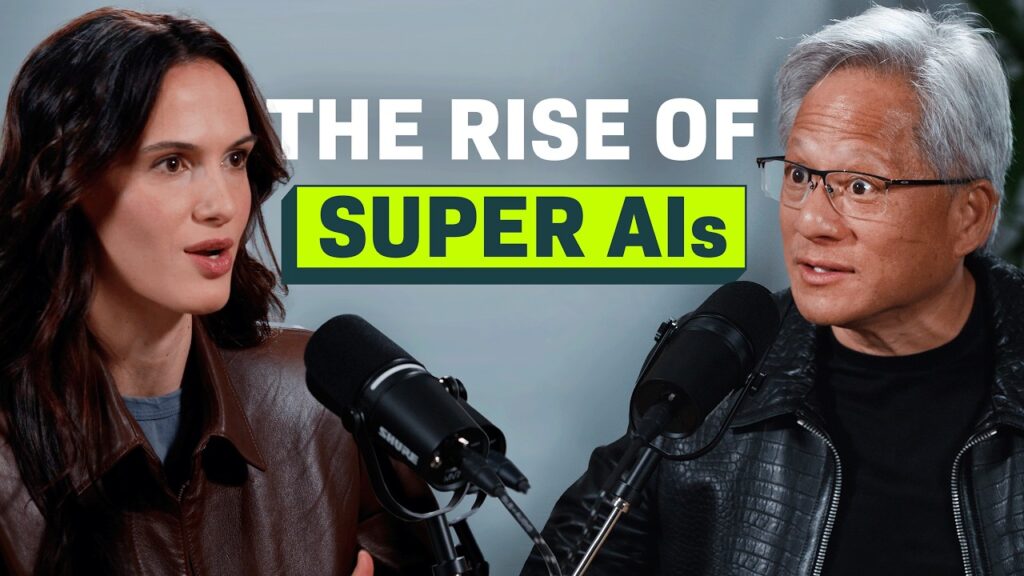

In Cleo Abram’s ‘Huge Conversations,’ Jensen Huang traces the journey from GPUs and CUDA to deep learning revolution, Omniverse, Cosmos, robotics, digital biology, energy efficiency and AI safety, explaining where computing and robotics are heading in the next 10 years. A complete guide that unfolds a 30-year vision in one conversation.
1. The goal of the conversation
Host Cleo Abram frames the interview as “hearing what a key architect of the future is imagining,” declaring she will ask Jensen three things: how we got here, what is happening right now, and what he’s trying to build next.
The audience ranges from teenagers who might not know the difference between CPU and GPU to experts in various fields, so the format is designed as a “joint explainer that even complete beginners can understand about the future of computing.”
2. The birth of GPUs: observing parallel processing
Jensen Huang recalls that when founding NVIDIA in the early 1990s, they observed that “10% of software code accounts for over 90% of total computation, and that 90% can be processed in parallel.”
“The remaining 90% of code must be processed sequentially, so the ideal computer must strongly support both sequential and parallel processing. NVIDIA started with the goal of building computers that accelerate problems traditional CPUs couldn’t solve.”
3. Why start with video games?
3D graphics required massive amounts of identical or similar computations performed simultaneously—a typical parallel processing problem. In the 90s, game developers wanted more realistic graphics, but existing hardware performance couldn’t keep up.
Jensen says “games were applications we loved, and simulating virtual worlds perfectly matched parallel processing.” He believed the gaming market would become huge, which would sustain the massive R&D needed for complex GPU architectures.
4. Why GPUs are ‘time machines’
Jensen describes GPUs as “time machines that let you see the future faster,” sharing a story of a quantum chemistry researcher who said “thanks to your GPU, I can complete my life’s research within my lifetime.”
From weather prediction and autonomous driving simulation to urban traffic simulation, GPU acceleration enables calculations that would otherwise be impossible or take decades to perform, making it possible to “see the future in advance.”
5. CUDA: opening parallel computing to everyone
Early researchers had to trick GPUs into thinking scientific workloads were graphics problems or use complex workarounds. The Mass General research team using graphics processors for medical imaging CT reconstruction provided internal inspiration.
NVIDIA created the CUDA platform to let developers command GPUs using familiar languages like C. Jensen says he could bet the whole company on CUDA because “thanks to the video game market, our GPUs would become the world’s best-selling parallel processors.”
6. AlexNet and the deep learning transformation
In 2012, the University of Toronto’s AlexNet team used NVIDIA GeForce GTX 580 with CUDA to overwhelmingly improve image recognition competition performance, transforming GPUs from simple accelerators into engines of an entirely new computational paradigm.
“Inside NVIDIA, we were frustrated with computer vision too. When we saw a completely different approach—deep neural networks on GPUs outperforming existing algorithms—we started redesigning around ‘how far can this method go, how can it transform the entire computer industry.'”
7. Reinventing the entire computing stack
He explains, “If deep learning architectures can scale sufficiently, most machine learning problems can be expressed, and the range of problems we can solve becomes wide enough to completely reshape the computer industry.” This led to the decision to restructure hardware, systems, and software entirely.
The result was AI supercomputer platforms like DGX, building a new “accelerated computing“-centered paradigm after 60+ years of general-purpose computing models maintained since IBM System/360.
8. Why maintain the big bet for a decade
When Cleo asks “why did it take 10 years after 2012 for people to actually experience AI and NVIDIA,” he answers that throughout those 10 years, success and uncertainty were mixed, but “as long as fundamental assumptions, physical laws, and industrial insights don’t change, there’s no reason to change beliefs.”
Even when investors wanted short-term profits, they invested billions of dollars upfront because of “belief in our future.” He says he’s had the same belief in NVIDIA for over 30 years, so he continues forward.
9. Core beliefs: accelerated computing and scalable AI
Jensen’s first core belief is that “accelerated computing combining general-purpose computing + parallel accelerated computing is the basic model for the future,” and this principle remains unchanged today.
The second belief is that deep neural networks have amazing ability to learn patterns and relationships from data, and the scaling law showing they learn more knowledge as networks and data grow has been verified, with no physical or mathematical limits yet visible.
10. Multimodal AI: text, images, proteins
He explains that deep learning can now handle not only image recognition, speech recognition, and language understanding but also “text→text summarization, language translation, text→image generation, image→text captioning, amino acid sequence→protein structure prediction”—transforming various data types into each other.
In the future, “protein→text description,” “designing new proteins with desired properties,” “words→video,” “words→robot action tokens” will naturally become possible, opening AI application opportunities to almost every industry and job.
11. From science to ‘AI application science’ era
While the past decade was about advancing AI science itself, the next decade will be the “AI application science” era, he defines. Applying AI to real industries and problems like digital biology, climate/energy, agriculture/fisheries, robotics, education, logistics, and media will become central.
He adds, “Because the speed and scope of change we’re experiencing are growing, we’re entering an era where accurately predicting future use cases we see now is much more difficult.”
12. Omniverse, Cosmos and robots’ ‘world models’
Using ChatGPT as an example, Jensen explains that first-generation models generated impressive sentences but had ‘hallucination’ problems when lacking knowledge or answering at length, and later versions improved accuracy by conditioning models with ‘ground truth’ like PDFs or search results.
Physical world robots similarly need ‘world foundation models’ embodying physical common sense like gravity, friction, inertia, object permanence, and causality. NVIDIA is combining Cosmos as a world model with physics simulator Omniverse to generate and learn from infinite scenarios based on physical laws.
13. “Everything that moves will become robotic”
He says “everything that moves will eventually become robotic, and that time isn’t far off.” Almost everything that moves, like lawn mowers or cars, will be automated, and humanoid robot technology will soon reach practical levels.
“Robots will learn by experiencing countless virtual futures in Omniverse and Cosmos before being deployed to the real world. Individuals will have their own AI companion (like R2-D2) that grows with them throughout life, accessible anywhere—smart glasses, phones, PCs, cars, homes.”
Practical Q&A · CEO Interview Essentials
5 Key CEO Insights
- Accelerated computing (CPU + GPU) started from observations 30 years ago and remains an unchanged core principle today
- Deep learning‘s scaling laws are verified, with no physical limits yet visible
- Omniverse and Cosmos are key platforms for teaching robots physical world common sense
- The future where everything that moves becomes robotic will be reality within 5-10 years
- AI safety isn’t about single models but community architecture with layered systems, humans, and regulations
Conclusion—What Jensen Huang wants to leave behind
Finally, regarding how he wants to be remembered, he says not simply for company value or stock price, but as someone who “expanded human potential and created computing platforms that helped scientists and engineers complete their life’s work within their lifetime.”
This interview provides a complete guide that surveys the 30-year arc from GPU, CUDA, deep learning to Omniverse and Cosmos, plus Jensen Huang‘s long-term vision of how the physical and digital worlds will combine through AI over the next 10 years. It clearly shows NVIDIA isn’t just a GPU manufacturer but a company redesigning all future computing, providing essential insights for everyone preparing for the AI, robotics, and digital biology era.